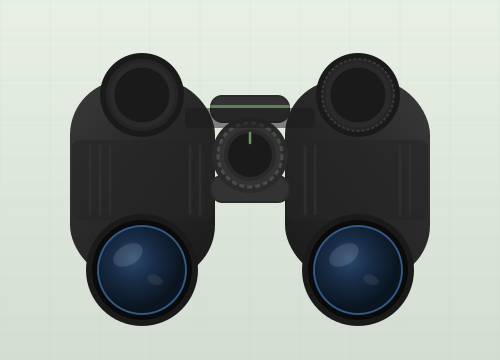
The Celestron Nature DX 8×42 is, in our testing, the best binocular available for under $150. It offers specifications that would have seemed implausible at this price point a decade ago: BAK4 prisms, fully multi-coated optics, O-ring waterproofing, nitrogen purging, and a 388-foot field of view that's wider than many binoculars costing three times as much. In bright daylight, a side-by-side comparison with mid-range binoculars is genuinely challenging.
The compromises are real but predictable: edge sharpness drops noticeably toward the periphery of the field, low-light performance falls short of phase-corrected alternatives, and the 2-year limited warranty is far less reassuring than the Vortex VIP. But for a beginner testing whether birding will become a genuine hobby, or for a young birder whose first pair of binoculars needs to be genuinely good without breaking the family budget, the Nature DX delivers remarkable performance.
The optics market has improved dramatically at the entry level. Binoculars that cost $149 in 2026 offer features that required $400+ as recently as 2015: BAK4 prisms, full multi-coating on all glass surfaces, O-ring waterproofing, and nitrogen purging. The Celestron Nature DX represents the best of this improvement. In bright conditions — which is most of backyard birding, park birding, and casual nature walks — it delivers images that are genuinely sharp, colorful, and detailed enough for confident bird identification.
The limitations emerge in challenging conditions: low light (dawn, dusk, shaded forest), edge-to-edge sharpness across a wide scan, and fine detail on distant birds where the absence of phase correction on the prisms reduces contrast. These are real limitations for serious birders, but they're irrelevant for casual use.
The Celestron Nature DX 8×42 is right for: a child or teenager getting into birding; an adult who wants to try birding without committing $400+; a casual birdwatcher who watches feeders and occasional park visits; anyone buying a second pair of binoculars to keep in the car. It is not the right choice for a serious birder who will be frustrated by its limitations within a season.
{'quote': "These are the binoculars I hand to guests on guided walks who forgot their own. They're never disappointed. The images are genuinely good."}
The upgrade path from the Nature DX leads naturally to the Vortex Diamondback HD 8×42 ($199) — better phase-corrected prisms, better close focus, and Vortex's unconditional warranty. Beyond that, the Nikon Monarch M7 8×42 ($429) adds ED glass. The Nature DX is not a permanent destination for a developing birder, but it's an excellent starting point.
The Nature DX uses BAK4 prisms — good. But they lack phase correction, which means light waves reflecting through the prism arrive slightly out of phase at the eyepiece, reducing contrast. This is most visible in low light and when looking at high-contrast subjects against a bright sky. Fully multi-coated optics maximize light transmission on a budget, but the coatings are less sophisticated than higher-end alternatives.
The practical result: in good light, the Nature DX is genuinely impressive. In challenging conditions, it shows its price. For the use cases where it excels, it's excellent value.
Full ranking table with specs, scores, and pricing side-by-side.
View Full Rankings →