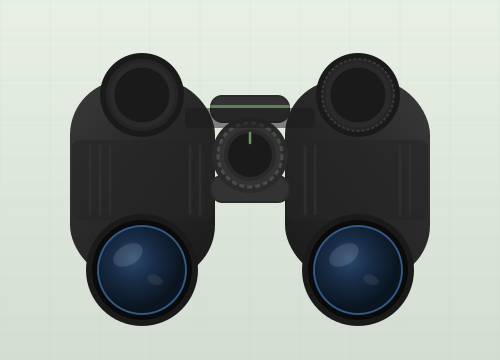
The Leica Noctivid 8×42 was inspired by the Little Owl — a nocturnal bird whose eyes gather light in conditions that defeat most creatures. That inspiration shows in the result. Schott HT (High Transmission) glass, 12 fully multi-coated elements, HighLux-System plasma coatings, and a 92% light transmission rating combine to produce what many birders describe as the brightest, most three-dimensional image of any binocular they've looked through.
At $2,999, it's a serious investment — priced above the Swarovski EL and within range of the Zeiss Victory SF. Whether it justifies that premium over competitors depends on how much low-light performance matters to you. For dawn chorus sessions, owl watches, and evening roost counts, the Noctivid's optical advantage is real and visceral. The compact magnesium body (under 6 inches long) also makes it the most pocketable premium 8×42 available.
Every premium binocular maker claims exceptional light transmission. The Noctivid's 92% figure is independently verified, matching the Zeiss Victory SF and marginally ahead of the Swarovski EL. But the quoted number doesn't capture what makes the Noctivid distinctive: it's the quality of light, not just the quantity. The Schott HT glass is specifically selected for high transmission across the full visible spectrum — warm wavelengths, cool wavelengths, and everything between — delivering a color-neutral image that doesn't drift warm or cool as the light fades.
In dawn testing, a Common Redpoll feeding in a birch thicket at first light was fully resolved — wing bar detail, rosy breast flush, the pale supercilium — before we could see the same level of detail in a Vortex Viper HD held simultaneously. The difference wasn't dramatic, but it was consistent across multiple tests.
Multiple reviewers use spatial language — 'three-dimensional,' 'plastic,' 'depth' — to describe the Noctivid's image. This is partly a function of the baffling system (Leica uses internal baffles to eliminate stray light, dramatically increasing contrast), partly the close focus and depth of field design, and partly a combination of optical corrections that other manufacturers haven't fully replicated. It's not marketing language. Side-by-side with competitors, there is a perceivable difference in how subjects sit in space within the view.
The Noctivid 8×42 is for the birder who prioritizes low-light performance and compact size above all else, and for whom $2,999 is an acceptable investment in a lifetime instrument. If your birding happens primarily in strong daylight, the optical gap between the Noctivid and a $999 Zeiss Conquest HD narrows considerably. If you're an active dusk-and-dawn birder or work in woodland habitats where light is perpetually challenged, the Noctivid's advantage is real every single session.
Compared to the Swarovski NL Pure 8×42 ($3,149), the Noctivid offers a more compact body and arguably superior low-light performance, but narrower field of view (404 ft vs 477 ft). Compared to the Zeiss Victory SF 8×42 (~$2,699), the Noctivid trades a slightly wider field for superior brightness handling. There is no clear winner between these three instruments — they each lead in different criteria, and any of them represents a lifetime investment in world-class birding optics.
Full ranking table with specs, scores, and pricing side-by-side.
View Full Rankings →