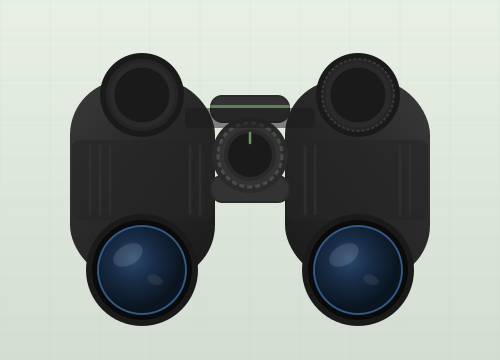
When Swarovski launched the NL Pure, they described it as 'the revolutionary binoculars with the largest field of view to date.' That claim stands in 2026. The 477-foot field of view at 1,000 yards is not a modest improvement — it's 15% wider than the previous Swarovski benchmark (the EL), and measurably wider than any competing 42mm binocular from any manufacturer at any price. Combined with field-flattener lenses that keep the full 477 feet crisp from center to edge, the NL Pure creates an immersive viewing experience that is qualitatively different from anything else available.
The 'wasp waist' single-bridge design allows the barrels to sit closer to your hands, shifting the center of gravity and reducing arm fatigue during extended sessions. The SWAROVISION coatings deliver 91% light transmission — marginally behind the Leica Noctivid's 92%, but in practical birding conditions the difference is imperceptible. At $3,149, the NL Pure is the most expensive binocular on this list, but for the birder who prioritizes field of view and immersion above all else, there is nothing that competes.
A binocular's field of view is typically described as a number — 477 feet at 1,000 yards for the NL Pure, compared to 360 feet for the Zeiss Victory SF 10×42, or 435 feet for the Nikon Monarch M7 8×42. But numbers don't capture the experience. The NL Pure's 477-foot field is so wide that in field use, the edges of the frame essentially disappear from awareness — you lose the sense of looking through an instrument and gain the sense of simply seeing a wider piece of the world.
This has direct practical implications. A fast-moving warbler that drops out of the top of the field in a conventional binocular may still be visible in the NL Pure. A hawk soaring toward the edge of view stays trackable longer. On a morning migration watch, you're covering more sky per second than with any competing binocular — which means more birds found, more birds identified, more birds.
The challenge of a very wide field of view is that conventional optical designs go soft at the edges — the wider the field, the worse the edge sharpness. Swarovski solved this with field-flattener lenses in the eyepiece assembly, which optically correct the curvature of field across the entire 477-foot view. The result is an image that is as sharp at the extreme edge as at the center — a technical achievement that required years of development and represents genuinely novel optical engineering.
The trade-off is a mild 'rolling ball' or 'swimming' sensation that some users notice when panning quickly. Not everyone perceives it, and those who do generally adapt within a few sessions. It's worth being aware of if you're highly sensitive to optical distortion.
The Swarovski EL 10×42 ($2,499) and the NL Pure 8×42 ($3,149) are the two flagship Swarovski binoculars, and comparing them is a question many serious birders face. The EL has 10× magnification — more reach for open habitats and distant identification. The NL Pure has the widest field of view of any 42mm binocular. For most forest and woodland birders, the NL Pure's 8× and 477-foot field is the better choice. For coastal, raptor, and open-country birders, the EL's 10× reach may serve better.
Either way, both represent a lifetime investment in the finest birding optics available. The NL Pure wins on field of view; the EL wins on reach. There is no universally correct answer.
Full ranking table with specs, scores, and pricing side-by-side.
View Full Rankings →