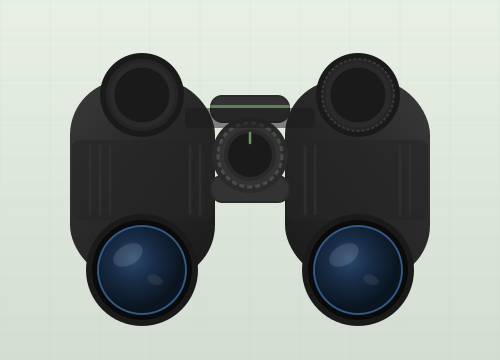
The Maven C.1 10×42 is the most decorated mid-range binocular in our lineup — named one of Field & Stream's "10 Best Binoculars of the Year" and winner of Outdoor Life's Great Buy Award. At $425, it delivers specifications and performance that binocular buyers would have associated with $800–$1,000 glass just a few years ago: ED glass for minimal chromatic aberration, phase-corrected BaK4 prisms, fully multi-coated lenses, and Maven's unconditional lifetime warranty.
The C.1 10×42 is the model most birders should buy if they're upgrading from entry-level glass and not yet ready to invest in the B.1.2. The 315-foot field of view is genuinely wide for birding in forest and dense cover, and the ED glass delivers clean, color-accurate images that hold up well against birds in bright sky. It's not as optically refined as the B.1.2 — the magnesium chassis and dielectric prism coatings of the flagship are missing — but at $425 it overdelivers substantially.
The Maven C.1 occupies an unusual position in the binocular market: it's a mid-range instrument by price that performs like a premium one. The combination of ED glass and phase-corrected prisms at $425 is genuinely uncommon — most competitors at this price either include ED glass without phase correction, or offer phase correction with ordinary glass. Maven includes both, and the result is a binocular that delivers images noticeably cleaner and more color-accurate than you'd expect from the price tag.
Field & Stream awarded the C.1 a spot on their annual "10 Best Binoculars" list, and Outdoor Life gave it their Great Buy Award. These aren't participation trophies — both publications test extensively across price classes, and the C.1 earned its recognition by outperforming competitors costing $600–$800.
Extra-low dispersion glass reduces chromatic aberration — the color fringing that appears as purple or green outlines around high-contrast subjects. For birders, this matters most when studying dark birds against bright sky, identifying birds by the color of wing patches and eye rings, or working in the high-contrast light of golden hour. Without ED glass, fine details get muddied by color fringe. With it, field marks resolve cleanly. The C.1 delivers this upgrade at a price where it's still unusual to find it.
The C.1 10×42 ($425) vs B.1.2 8×42 ($950) comes down to three things: the B.1.2 has dielectric prism coatings (higher light throughput), a wider 420ft field of view vs 315ft, and a closer 4.9ft minimum focus vs the C.1's longer close focus. The B.1.2 chassis is also magnesium vs the C.1's polymer. These are real differences — the B.1.2 is a meaningfully better optical instrument. But the C.1 at $425 is also a meaningfully better value for most birders who don't yet need the last 10–15% of optical performance the flagship offers. Start with the C.1, and you'll know if you ever need to upgrade.
The full Maven lineup reviewed and ranked against every major brand.
View Full Rankings →The 10×42 is for birders who do a lot of open-country work — coastal flats, hawk ridges, reservoirs — where extra reach matters. The 8×42 has a wider field and is easier to hold steady. Both are $425 with identical warranty and build quality; the choice is purely about your birding context.
The Monarch M7 10×42 ($429) and Maven C.1 10×42 ($425) are near-identical in price. The Maven has better close focus (5.5ft vs Nikon's 8.2ft) and an unconditional warranty vs Nikon's 25-year limited. The Nikon has slightly better eye relief (17mm vs Maven's 16.5mm) — meaningful for glasses wearers.
Maven's C.1 series is manufactured in Japan, at facilities that also supply optical components to several European binocular brands. Maven's direct-to-consumer model removes retail markup, allowing Japanese-made glass to be priced competitively against Chinese-made alternatives at the same price point.