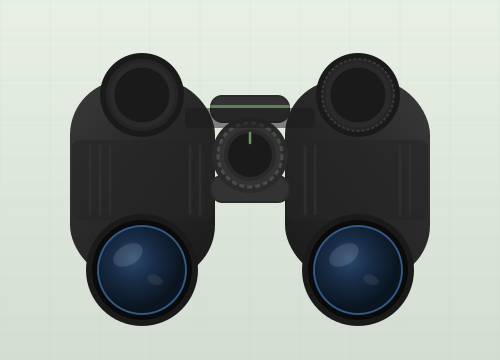
The Maven C.4 15×56 occupies a niche that most binocular manufacturers underserve: a high-power, tripod-mounted binocular with genuine optical quality at a mid-range price. At $650 for the 15×56 configuration, it delivers the same dielectric-coated Schmidt-Pechan prism system used in the flagship B.1.2, paired with 56mm objective lenses and ED glass — a specification sheet that competes with binoculars costing $1,200 or more.
This is not a binocular for hand-held use. At 45.1 oz and 15× magnification, it demands a tripod. Birders who do hawk watches, open-country raptor surveillance, or shorebird scanning from fixed positions will find it transformative. The ability to detect fine field marks and color detail at distances where other binoculars show blurry silhouettes is the C.4's defining capability — and at $650, the price-to-performance ratio is exceptional.
The C.4 15×56 has a narrow but passionate audience: birders who spend significant time stationary, glassing open terrain from a fixed position. Hawk watch sites. Shorebird flats. Open grasslands for raptors. Pelagic birding from a fixed platform. In these contexts, 15× magnification mounted on a tripod transforms what's possible — distant birds that appear as specks in standard binoculars resolve into identifiable species with fine field marks visible.
If you regularly carry binoculars on long hikes or forest trails where mobility matters, the C.4 is not your instrument. At 45.1 oz and requiring a tripod, it's a dedicated stationary optic. But for the birder who operates in open country and has been frustrated by the limitations of standard 10×42 binoculars at distance, the C.4 represents a step change in observational capability.
The C.4's most significant specification is the dielectric-coated Schmidt-Pechan prism system — the same prism design used in the flagship B.1.2. Dielectric coatings on roof prisms reflect more light than standard silver or aluminum coatings, resulting in brighter images across the brightness spectrum. Combined with 56mm objectives and ED glass, the C.4 produces images at 15× that retain genuine brightness and clarity rather than the dim, contrast-challenged views that many high-power binoculars deliver.
Edge sharpness does trail true premium 15×56 glass (Swarovski, Zeiss, Leica) — this is a real limitation acknowledged by all reviewers who've compared them directly. Center-field performance, however, was rated as competitive with binoculars costing two to three times as much by multiple independent testers who used them on extended hunts and birding trips across temperature ranges from below freezing to desert heat.
Maven's B.5 15×56 costs approximately $1,400 — more than double the C.4. The B.5 uses fluorite glass (a step above ED), an Abbe-Koenig prism design for superior light transmission, and a magnesium chassis. The optical performance gap is real but not dramatic in the center field. Edge sharpness and eyebox are where the B.5 clearly pulls ahead. For most birders operating the C.4 from a tripod and observing center-frame, the C.4 at $650 captures 80–85% of the B.5's performance at 47% of the price — an exceptional ratio.
The full Maven lineup — from $425 mid-range to $950 flagship — reviewed and ranked.
View Full Rankings →The C.4 15×56 is a specialist tool for birders who need high-magnification scanning: waterfowl counts on open water, hawk watches from a fixed position, shorebird survey work at long range, or pelagic birding. It's not a general-purpose birding binocular. If you're asking whether you need it, you probably don't.
Yes, for sustained use. The C.4 15×56 benefits significantly from a monopod or tripod for anything beyond brief target acquisition. Hand-holding 15× binoculars for more than a minute produces fatigue and significant image shake. Budget $30–$50 for a basic monopod if you buy this pair.
At fixed magnification, a good spotting scope (20–60×) will resolve more detail than 15× binoculars at range. The C.4's advantage is speed and wide field vs a scope — you can scan a large expanse of water quickly and both eyes open. For mixed scanning and close examination, 15×56 binoculars + a scope is a common combination for serious shorebirders.