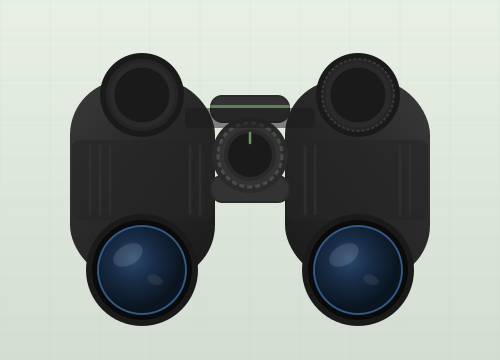
Nikon has made quality optics for over a century, and that heritage shows even at the entry level. The Prostaff P3 8×42 delivers multilayer coatings, a silver-alloy roof prism, and Nikon's precise optical alignment at a price that undercuts the competition. In center-image clarity — the metric that matters most for bird identification — the Prostaff P3 genuinely surprises reviewers who expect budget-level performance.
The practical limitations are real: the silver-alloy prism coating is less efficient than phase-corrected BAK4, resulting in lower contrast in challenging light. The 10-foot close focus is one of the worst on this list, making it frustrating for feeder watching when birds are close. Eye relief of 15.4mm is borderline for glasses wearers. And the 1-year warranty is the shortest of any binocular we review. The Vortex Diamondback HD at $199 addresses all of these limitations — but if the Nikon name and heritage mean something to you, or you find it on sale, the P3 is a decent entry point.
Nikon has been making precision optics since 1917. Their manufacturing tolerances, optical alignment, and quality control processes are consistent across their product lines in ways that cheaper brands cannot match. When you buy a Nikon Prostaff P3, you're getting optics that are built to Nikon specifications — which means the image you see through the center of the field will be sharp, well-aligned, and color-accurate in a way that $50 no-name binoculars simply can't deliver.
This matters at the entry level precisely because beginners often can't diagnose what's wrong with a bad binocular. They just know it doesn't feel right — hard to focus, misaligned, colors off. With the Prostaff P3, those problems don't exist. The optics are honest and well-built.
The Prostaff P3's 10-foot minimum focus distance is a genuine limitation for backyard birders. If you have a feeder mounted close to a window, or if you like to watch birds feeding at the base of a hedge, you will regularly find yourself unable to focus on the subject. The Vortex Diamondback HD's 5-foot minimum focus is the more practical specification for this common use case.
For birders who primarily watch at medium to long distances — open areas, wetlands, parks — the 10-foot close focus is rarely a problem. It's specifically the feeder-watcher and woodland birder who will notice it.
The Prostaff P3 and the Celestron Nature DX are directly competitive at similar price points. The Celestron wins on close focus (6.5ft vs. 10ft), field of view (388ft vs. 377ft), and waterproofing (full waterproof vs. splash-proof). The Nikon wins on brand reputation, center sharpness, and (marginally) on build feel. For most beginners, the Celestron Nature DX is the better all-around value. The Prostaff P3 is a reasonable alternative if you find it cheaper or prefer the Nikon name — but don't pay more for it than the Celestron.
Full ranking table with specs, scores, and pricing side-by-side.
View Full Rankings →